Wednesday, August 28, 2013

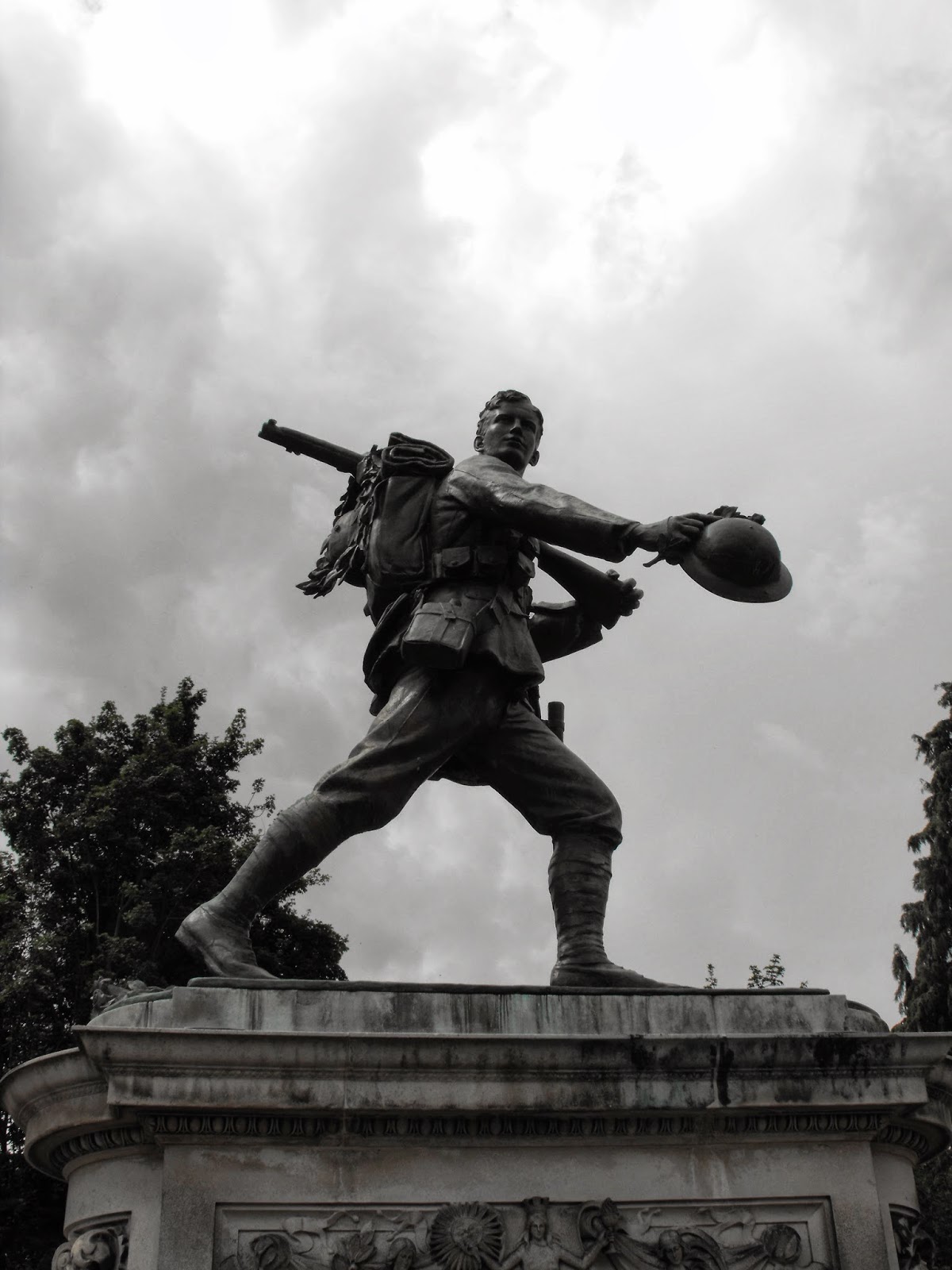
Coming Home in Triumph in 1918?


 As I have traveled over the years it has become apparent that almost every community in the “western” world has its collection of memorials to those who participated in the conflicts that marked its history. Memorials relating to the American Civil War appear to be the most numerous in the United States, but I believe that in the United Kingdom that position is claimed by the First World War. One of the discoveries I made in researching for this blog is that Britain's Imperial War Museum maintains an outstanding online database of war memorials.

Many of these British First World War memorials are rather austere and even plain cenotaphs or obelisks, etc., reflecting to some degree or another the grief associated with the scale of the losses from the Great War. When they do feature something more, it is often a mournful figure draped in ancient robes or a soldier marked by his stillness and lack of movement or evident energy. The Northumberland Fusiliers monument is an interesting exception in that it features a group of soldiers leaving for the war and surrounded by family, friends, and well-wishers.

But this memorial in Cambridge is the only British memorial that I can recall as presenting any hint or note of triumph. Entitled “The Homecoming”, it was originally It was originally unveiled and dedicated on July 3, 1923 by His Royal Highness the Duke of York - the future King George VI.

Today it is located at the intersection of Hills Road and Station Road (and the Botanical Gardens there) – the latter leading to the railway station that serves the city of Cambridge, the location to which it was moved in 2012.


The memorial includes a single soldier from the ranks, representing the many men of Cambridgeshire who went off to the war. This figure, however, is striding boldly possibly even gleefully homeward from the wars. The Imperial War Museum's database offers some background information on this memorial.


The memorial was dedicated
"TO THE MEN OF CAMBRIDGESHIRE
AND THE ISLE OF ELY, THE BOROUGH
AND UNIVERSITY OF CAMBRIDGE
WHO SERVED IN THE GREAT WAR
1914-1919
AND IN THE WORLD WAR/ 1939-1945"

- the reference to the Second World War of course being a later addition.


He bears laurel garlands of triumph in his kit and wreathed around the German stahlhelm that is his trophy from the battlefield and signet of victory.


The statue bears the name of its sculptor the names of the memorials sponsors are inscribed on the base. Robert Tait McKenzie was a Canadian American surgeon and sculptor whose interest in the latter reflects and may have been inspired in part by his interest in anatomy and physical fitness. His papers today are now at the University of Pennsylvania.


A very similar (apparently identical) work in the United States is called "The Victor" and was erected in 1925 as a part of the War Memorialin Woodbury, New Jersey. The similarities to “The Homecoming” are evident as are the changes to make this figure a World War I doughboy facing straight ahead as he marches. Personally, I prefer the English version as the soldier’s posture looking to one side from his line of march is much more evocative of the already easing of discipline and the anticipated return to the hard earned joys of peace this soldier would have felt. A Philadelphia Buildings website also presents drawings and other background material on "The Victor" including drawings of how it would look while still merely a proposal. These drawings show how it was already planned for this figure to be different than the one used in "The Homecoming" in Cambridge.

The figure of the British soldier in "The Homecoming" also offers some great details on what his kit would have looked like and how it would have been worn.


Thursday, July 4, 2013

Brush Up Your Clausewitz


I am spending some of this year rereading Clausewitz’ On War and at a friend’s suggestion will try to share the experience here. Given the size and complexity of the work, the discussion is likely to be as episodic as the book itself.

As is often the case with a work not written originally in English, the first question is which translation to read. I’m reading the Eighth Printing of the Indexed Edition that came out in 1984 which was the text used when I first read On War at the US Naval War College Command and Staff Course, 1986-1987. This version was translated by Angus Malcolm and Elsbeth Lewin, edited by Peter Paret and Michael Howard, and indexed by Rosalie West (modeling this on the index presented in Professor Werner Hahlweg’s 1952, 1972, and 1980 German editions). The translation upon which this latest edition is based went back to that 1832 edition, supplemented by the annotated German text prepared and published in 1952 by Professor Werner Hahlweg. The addition of the index addressed one of the most telling complaints first registered against the Paret/Howard version.

The Editor’s Note is the first of several introductions and essays that preface the actual text of this translation of On War. Here the editors explain that this is actually the third translation into English of On War. The first was by Colonel J J Graham in 1874, republished in 1909 in London. Unfortunately, this is considered to be both dated in style and suffering from a “large number of inaccuracies and obscurities” primarily it appears because he based his translation on the third German language edition of On War, which is considered to have suffered at the hands of its German editors. It is worth noting that Graham had himself authored a rather complex work on strategy in 1858 entitled Elementary History of the Progress of the Art of War. There is an interesting article on this background at http://www.clausewitz.com/readings/OnWar1873/Translator.htm though the author refers to the earlier Paret-Howard edition which did not have the index included in my edition.

A second translation by Professor O J Matthijs Jolles and was published in New York in 1943, a wartime translation to support the War Department. Both Graham’s and Jolles’ translations were based upon German texts that were significantly different from the 1832 First Edition.

The editors also reviewed four notes that were printed in that 1832 edition, but written by Clausewitz at different times between 1816 and 1830 to be an introduction. These are presented here in the order in which the editors believe they were actually written (rather than as published in previous editions). They argue that in the sequence presented here, the notes explain how On War took shape in the author’s mind and what he had in mind for its final form. They also dropped the previously used Preface by Marie von Clausewitz which was focused more upon how that first edition was prepared and did not address the subject of the book itself.

Since reading this and related articles I’ve picked up copies of the other translations and will have to compare them after I’ve finished rereading the Paret/Howard version again.

Tuesday, June 25, 2013

Whistle Blows Snowden into Injury Time?

I like whistleblowers. I dodged a military career because I had read enough to know that generals do not like to hear you say, "Sir, that is the dumbest idea I've ever heard." No one told me that ambassadors don't like it either.

But governments need to be reminded every once in a while by whistleblowers that all of their employees are also taxpayers and voters and citizens - and at least some of them will live up to those obligations by calling out the government when it forgets who it is supposed to serve. Some of these people are just cranks but some are genuine whistleblowers and their efforts force a change in how we do things and how our government does things.

Snowden seems to be moving beyond that role and appears increasingly to be simply the guy who didn't get it and didn't fit in. It may be that he will yet turn out to be the Daniel Ellsberg of government eavesdropping - but the jury is still out on that.

Do I think that what he has done will help or hurt the US? Yes - on both. Do I think he should be punished under the law? Yes. One of the things about being a whistleblower versus a mere crank, is that the whistleblower stands up and takes the chance that his eventual punishment under the law will be mitigated by a general conclusion that he or she has actually done both government and citizenry a public service. I realized a long time ago that one person can accomplish anything - as long as they are also willing to pay the price.
This post appeared earlier today on The Military Philosopher on Face Book, inspired by this article from Foreign Policy: 
Whistleblowers: Thanks for Nothing, Snowden
blog.foreignpolicy.com
When Edward Snowden first started revealing secrets about the National Security Agency's massive surveillance operations, the small community of U.S. government whistleblowers and their advocates publicly leapt to Snowden's