Pete Seeger has been there as long as I can remember, like that cousin or uncle who lived
somewhere else but would show up from time to time – often rather unexpectedly
but always welcome in the end even if sometimes you had to first recover from
the surprise. He seems to have even then
been well-established as the paterfamilias of the folk scene that was still
around as I became musically aware back in the 1960s and the bonds are still
there to be seen if you look just a little bit.
I went to see Inside Llewyn Davis recently and it was a trip back in time.
I also realized that I need to clean up my MP3 player and set up a good
folk music playlist.
But the bond I didn’t recognize until it hit me between the
eyes as I read through the various print and online articles about our lost troubadour
is that he came by it honestly and his reach goes back even beyond his own
lifetime. Almost ironically as we ponder
this in 2014 – 100 years from the date of the beginning of the First World War
in Europe – I learn that Pete Seeger had an uncle among the soldier poets of that
war.
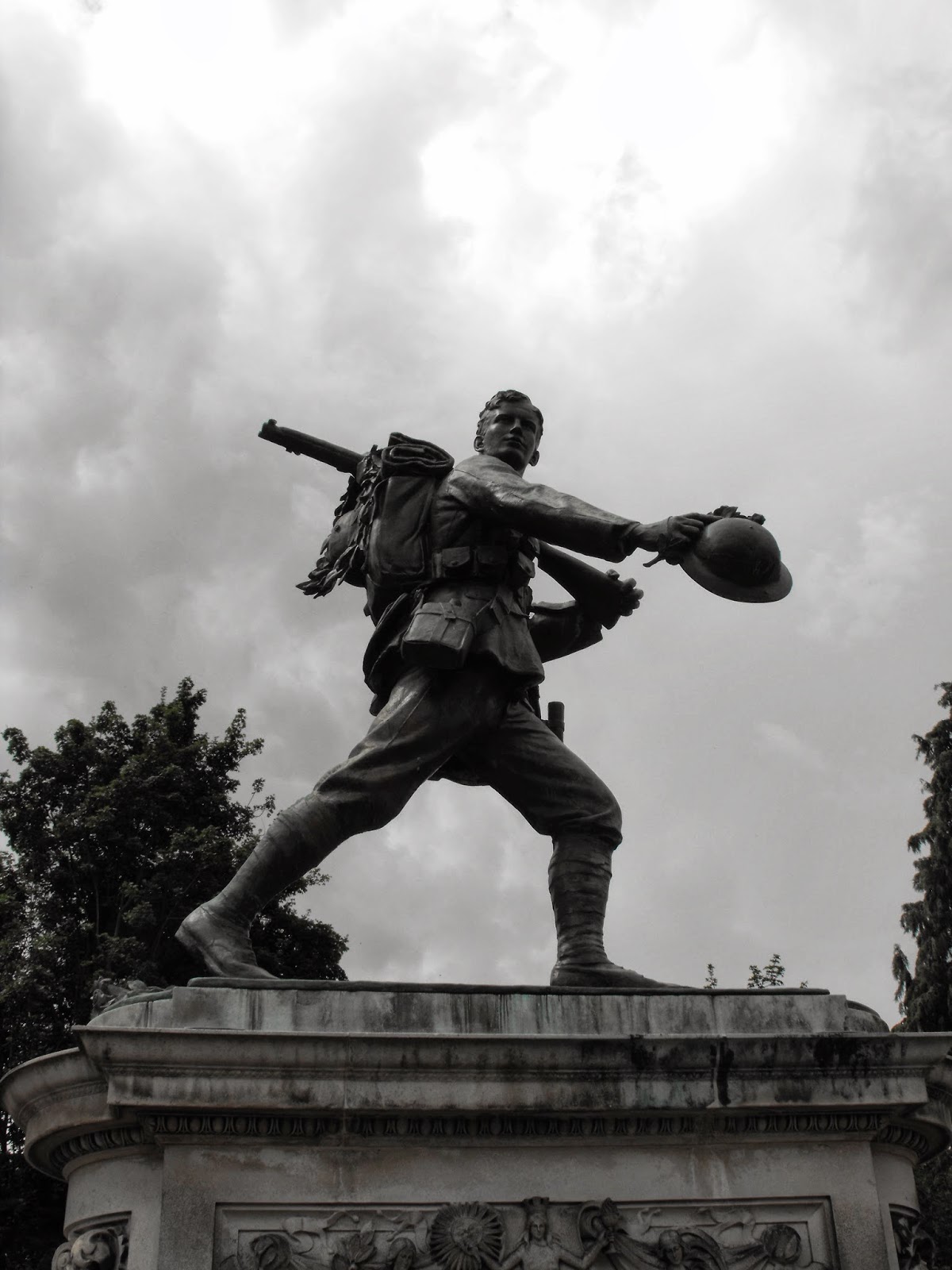
His name was Alan Seeger. Born in New York City in 1880, he went
to Harvard University, graduating in 1910.
Already a poet at Harvard, he moved back to New York City adopting a
bohemian lifestyle there before relocating to Paris. When war was declared in 1914, he enlisted in
the French Foreign Legion – 2e Régiment étranger (the United States not
entering the war until 1917).
As a
soldier of France, he was killed by German machine gun fire on July 4, 1916 at
Belloy-en-Santerre during the early days of the Battle of the Somme in 1916. I’ve known perhaps his most famous poem for
years and it was apparently also a favorite of President John F. Kennedy, “I
Have a Rendezvous with Death” but never
made the connection to the author of “Where Have All the Flowers Gone” before now.
I Have a Rendezvous with
Death
I have a rendezvous with Death
At some disputed barricade,
When Spring comes back with rustling shade
And apple-blossoms fill the air—
I have a rendezvous with Death
When Spring brings back blue days and fair.
It may be he shall take my hand
And lead me into his dark land
And close my eyes and quench my breath—
It may be I shall pass him still.
I have a rendezvous with Death
On some scarred slope of battered hill
When Spring comes round again this year
And the first meadow-flowers appear.
God knows ‘twere better to be deep
Pillowed in silk and scented down,
Where Love throbs out in blissful sleep,
Pulse nigh to pulse, and breath to breath,
Where hushed awakenings are dear:
But I’ve a rendezvous with Death
At midnight in some flaming town,
When Spring trips north again this year,
And I to my pledged word am true,
I shall not fail that rendezvous.
The Aisne (1914-1915)
We first saw fire on the tragic slopes
Where the flood-tide of France’s early gain,
Big with wrecked promise and abandoned hopes,
Broke in a surf of blood along the Aisne.
The charge the heroes left us, we assumed,
What, dying, they reconquered, we preserved,
In the chill trenches, harried, shelled, entombed,
Winter came down on us, but no man swerved.
Winter came down on us. The low clouds, torn
In the stark branches of the riven pines,
Blurred the white rockets that from dusk till morn
Traced the wide curve of the close-grappling lines.
In rain, and fog that on that withered hill
Froze before dawn, the lurking foe drew down;
Or light snows fell that made forlorner still
The ravaged country and the ruined town;
Or the long clouds would end. Intensely
fair,
The winter constellations blazing forth---
Perseus, the Twin, Orion, the
Great Bear—
Gleamed on our bayonets pointing to the north.
And the lone sentinel would start and soar
On wings of strong emotion as he knew
That kinship with the stars that only War
Is great enough to lift man’s spirits to.
And ever down the curving front, aglow
With the pale rockets’ intermittent light,
He heard, like distant thunder, grown and grow
The rumble of far battles in the night, --
Rumours, reverberant, indistinct, remote,
Borne from red fields whose martial names have won
The power to thrill like a far trumpet note,--
Vic, Vailly, Soupir, Hurtelise, Craonne…
Craonne, before thy cannon-swept plateau,
Where like sere leaves lay strewn September’s dead,
I found for all things I forfeited
A recompense I would not now forgo.
For that high fellowship was ours then
With those who, championing another’s good,
More than dull Peace or its poor votaries could,
Taught us the dignity of being men.
There we drained deeper the deep cup of life,
And on sublime summits came to learn,
After soft things, the terrible and stern,
After sweet Love, the majesty of Strife;
There we faced under those frowning heights
The blast that maims, the hurricane that kills;
There where the watch-lights on the winter hills
Flickered like balefire through inclement nights;
There where, firm links in the unyielding chain,
Where fell the long-planned blow and fell in vain—
Hearts worthy of the honour and the trail,
We helped to hold the lines along the Aisne.
Champagne, 1914-1915
In the glad revels, in the happy fetes,
When cheeks are flushed, and
glasses gilt and pearled
With the sweet wine of France that concentrates
The sunshine and the beauty of
the world,
Drink sometimes, you whose footsteps yet may tread
The undisturbed, delightful
paths of Earth,
To those whose blood, in pious duty shed,
Hallows the soil where the same
wine had birth.
Here, by devoted comrades laid away,
Along our lines they slumber
where they fell,
Besides the crater at the Ferme d’Alger
And up the bloody slopes of La
Pompelle,
And around the city whose cathedral towers
The enemies of Beauty dared
profane,
And in the mat of multicolored flowers
That clothe the sunny
chalk-fields of Champagne.
Under the little crosses where they rise
The soldier rests. Now round him undismayed
The cannon thunders, and at night he lies
At peace beneath the eternal
fusillade…
That other generations might possess—
From shame and menace free in
years to come—
A richer heritage of happiness,
He marched to that heroic
martyrdom.
Esteeming less the forfeit that he paid
Than undishonored that his flag
might float
Over the towers of liberty, he made
His breast the bulwark and his
blood the moat.
Obscurely sacrificed, his nameless tomb,
Bare of the sculptor’s art, the
poet’s lines,
Summer shall flush with poppy-fields in bloom,
And Autumn yellow with maturing
vines.
There the grape-pickers at their harvesting
Shall lightly tread and load
their wicker trays,
Blessing his memory as they toil and sing
In the slant sunshine of
October days…
I love to think that if my blood should be
So privileged to sink where his
has sunk,
I shall not pass from Earth entirely
But when banquet rings, when
healths are drunk,
And faces that the joys of living fill
Glow radiant with laughter and
good cheer,
In beaming cups some spark of me shall still
Brim toward the lips that once
I held so dear.
So shall one coveting no higher plane
Than nature clothes in color
and flesh and tone,
Even from the grave put forward to attain
The dreams youth cherished and
missed and might have known,
And that strong need that strove unsatisfied
Toward earthly beauty in all
forms it wore,
Not death itself shall utterly divide
From the beloved shapes it
thirsted for.
Alas, how many an adept for whose arms
Life held delicious offerings
perished here,
How many in the prime of all that charms,
Crowned with all gifts that conquer
and endear!
Honor them not so much with tears and flowers,
But you with whom the sweet
fulfillment lies,
Where in the anguish of atrocious hours
Turned their last thoughts and
closed their dying eyes,
Rather when music or bright gathering lays
Its tender spell, and joy is uppermost,
Be mindful of the men they were, and raise
Your glasses to them in one
silent toast.
Drink to them—amorous of dear Earth as well,
They asked no tribute lovelier
than this—
And in the wine that ripened where they fell,
Oh, frame your lips as though
it were a kiss.
Champagne, France, July, 1915
Where Have All the Flowers Gone?
Pete Seeger (as performed by Peter, Paul, and Mary)
Where have all the flowers gone, long time passing?
Where have all the flowers gone, long time ago?
Where have all the flowers gone?
Young girls have picked them everyone.
Oh, when will they ever learn?
Oh, when will they ever learn?
Where have all the young girls gone, long time passing?
Where have all the young girls gone, long time ago?
Where have all the young girls gone?
Gone for husbands everyone.
Oh, when will they ever learn?
Oh, when will they ever learn?
Where have all the husbands gone, long time passing?
Where have all the husbands gone, long time ago?
Where have all the husbands gone?
Gone for soldiers everyone
Oh, when will they ever learn?
Oh, when will they ever learn?
Where have all the soldiers gone, long time passing?
Where have all the soldiers gone, long time ago?
Where have all the soldiers gone?
Gone to graveyards, everyone.
Oh, when will they ever learn?
Oh, when will they ever learn?
Where have all the graveyards gone, long time passing?
Where have all the graveyards gone, long time ago?
Where have all the graveyards gone?
Gone to flowers, everyone.
Oh, when will they ever learn?
Oh, when will they ever learn?
Where have all the flowers gone, long time passing?
Where have all the flowers gone, long time ago?
Where have all the flowers gone?
Young girls have picked them everyone.
Oh, when will they ever learn?
Oh, when will they ever learn?
Where have all the flowers gone, long time ago?
Where have all the flowers gone?
Young girls have picked them everyone.
Oh, when will they ever learn?
Oh, when will they ever learn?
Where have all the young girls gone, long time passing?
Where have all the young girls gone, long time ago?
Where have all the young girls gone?
Gone for husbands everyone.
Oh, when will they ever learn?
Oh, when will they ever learn?
Where have all the husbands gone, long time passing?
Where have all the husbands gone, long time ago?
Where have all the husbands gone?
Gone for soldiers everyone
Oh, when will they ever learn?
Oh, when will they ever learn?
Where have all the soldiers gone, long time passing?
Where have all the soldiers gone, long time ago?
Where have all the soldiers gone?
Gone to graveyards, everyone.
Oh, when will they ever learn?
Oh, when will they ever learn?
Where have all the graveyards gone, long time passing?
Where have all the graveyards gone, long time ago?
Where have all the graveyards gone?
Gone to flowers, everyone.
Oh, when will they ever learn?
Oh, when will they ever learn?
Where have all the flowers gone, long time passing?
Where have all the flowers gone, long time ago?
Where have all the flowers gone?
Young girls have picked them everyone.
Oh, when will they ever learn?
Oh, when will they ever learn?
Thanks, Peter – thank you for everything, Alan .