Showing posts with label Britain. Show all posts

Tuesday, December 24, 2013

“I Need the COIN Cart in here, STAT!!” - Lessons on Counterinsurgency from the Human Body


A Commentary upon the program presented by General Stanley A. McChrystal (ret.), and Kristina Talbert-Slagle

General McChrystal and Dr. Talbert-Slagle gave an interesting presentation December 19 at The Brookings Institution on “Lessons on Counterinsurgency from the Human Body.”  The concept they presented, that the process of fighting an infection like HIV/AIDS in the human body offered parallels and insights into fighting a counterinsurgency campaign in a nation-state, is not new but neither was their presentation a waste of time.  The metaphor imagining a nation or society as a human body or biological organism dates back to the Renaissance.  As recently as the 1950s, officials spoke of fighting off the infection of communism in the USA and abroad.  Nevertheless, it may be that by the power of PowerPoint they presented this notion more effectively and thoughtfully than it has been in the past.

Right at the beginning of their presentation I really appreciated Dr. Talbert-Slagle’s comment that the body is a system of systems, an important concept for understanding both the human body and the body politic.  What the metaphor also offers is a clearer picture of the two-pronged approach that is the basis of counterinsurgency – one line of effort confronts the infection itself while the second line of effort addresses the challenge of maintaining and increasing the body’s strength to better fight off the infection.  This translates into a military effort against the insurgent combat arm and another line of effort to strengthen the current political/social/governmental institutions.

Their presentation included many references to Afghanistan and a lesser degree to Iraq, although I personally saw an even better match with Ireland from 1916 to 1923, a focus of my own recent research.  Ireland in this period is an excellent model which also highlights several additional and useful elements of the infection/insurgency metaphor.

For example, one reason the British authorities were not more alarmed over a possible rising during 1914, 1915, and into early 1916 was the proliferation of armed marching groups in Ireland that had been active over these years.  The British authorities were aware of the Ulster Volunteers, MP John Redmond’s Irish National Volunteers, MacNeil and Pearse’s Irish Volunteers, James Connolly’s Irish Citizen Army, and the Ancient Order of Hibernians Rifles.  Of these, the most dangerous were actually the smallest – Pearse’s Irish Volunteers and the Irish Citizen Army.  These would actually turn out for the Easter 1916 Rising.  Within the infection metaphor, each of the marching groups represented a separate infection.  This multiplicity of active “infections” served to mask the activities of the others making it harder for the government to make a timely diagnosis of which was the real threat requiring treatment.

Another critically important parallel between COIN and fighting infection is the need for the active participation of the patient.  Both geopolitical and medical experience suggest that it is critically important in counterinsurgency for the population and their leadership (in government and otherwise) to buy in to the COIN effort, just as the medical patient must take an active role alongside his or her doctor in deciding upon an effective course of treatment.

One questioner interjected an interesting issue when he noted that the earliest cases of HIV/AIDS occurred among gay men and that the associated stigma delayed serious action by the medical world, politicians, and society at large for several years.  While this point was acknowledged but not elaborated on during the presentation, I believe that a similar problem of stigma can be identified in connection with a state confronted by an insurgency.  Insurgencies almost always emerge in failing or failed states seriously troubled by corruption and poverty and related increases in violence and criminal activity, among other factors.  These and other signs of the breakdown of the state stigmatize that state and reduce the willingness of other governments and their electorates to be associated with the regime now targeted by an insurgency.  The troubled nation and its population have become “the other” – distinct and separate from the “us” of the US and the Western world.

The association of the metaphor and the already noted situation in Ireland gave rise to another thought as I pondered the implications of the metaphor.  Following the defeat of the Easter 1916 Rising, the British quarantined the infection by executing 16 people they identified as ringleaders and imprisoned almost 1,500 others identified as participants.  Although the situation in Ireland did not then worsen, it also did not return to the pre-Rising “normal”.  About a year later, Britain began releasing its prisoners and allowing them to return to Ireland.

These returning prisoners were in fact even more determined to win Ireland’s independence after their year in prison.  They returned with greater cohesion, unity, and purpose than before. In effect, Britain now faced a super-bug in Ireland, resistant to the treatments used in the past.  Ireland suffered a relapse as a new, more violent, prolonged conflict now broke out.  Finally, in 1922, Britain and Ireland signed a treaty ending British rule in Ireland.  Medically, what had happened over the period 1914-1922 was that the patient and physician had disagreed upon the proper course of treatment and neither really anticipated the dangers of reinfection by a new stronger (more virulent?) form of the ‘virus’.

What the two speakers have presented to us is not a solution to the challenges of insurgency and counterinsurgency warfare. They have revived and improved a metaphor that will help many people better understand the issues and challenges of counterinsurgency. The better both patient and physician understand the challenges and each other, the more likely they will successfully treat the disease.

Wednesday, August 28, 2013

Coming Home in Triumph in 1918?


 As I have traveled over the years it has become apparent that almost every community in the “western” world has its collection of memorials to those who participated in the conflicts that marked its history. Memorials relating to the American Civil War appear to be the most numerous in the United States, but I believe that in the United Kingdom that position is claimed by the First World War. One of the discoveries I made in researching for this blog is that Britain's Imperial War Museum maintains an outstanding online database of war memorials.

Many of these British First World War memorials are rather austere and even plain cenotaphs or obelisks, etc., reflecting to some degree or another the grief associated with the scale of the losses from the Great War. When they do feature something more, it is often a mournful figure draped in ancient robes or a soldier marked by his stillness and lack of movement or evident energy. The Northumberland Fusiliers monument is an interesting exception in that it features a group of soldiers leaving for the war and surrounded by family, friends, and well-wishers.

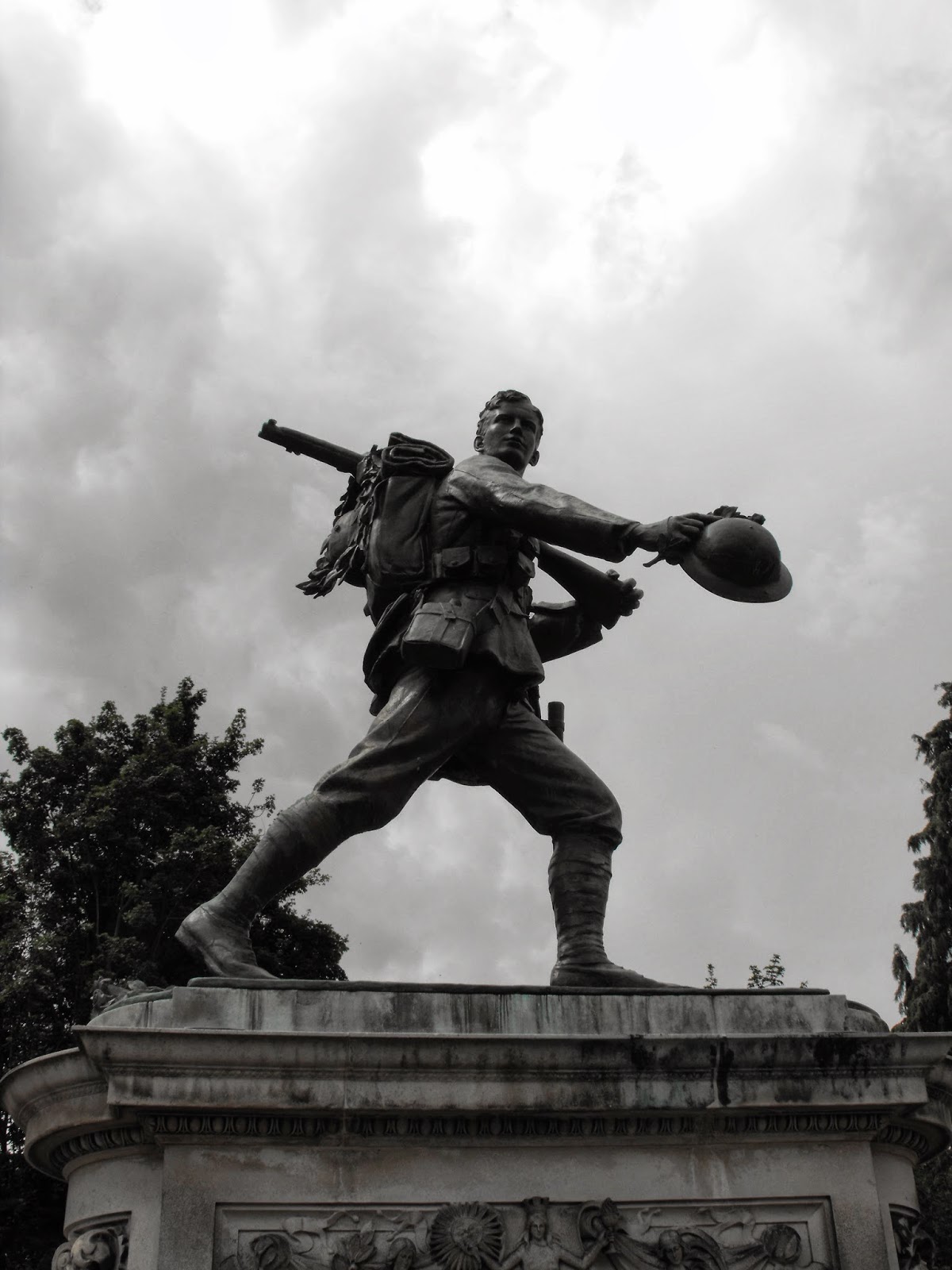
But this memorial in Cambridge is the only British memorial that I can recall as presenting any hint or note of triumph. Entitled “The Homecoming”, it was originally It was originally unveiled and dedicated on July 3, 1923 by His Royal Highness the Duke of York - the future King George VI.

Today it is located at the intersection of Hills Road and Station Road (and the Botanical Gardens there) – the latter leading to the railway station that serves the city of Cambridge, the location to which it was moved in 2012.


The memorial includes a single soldier from the ranks, representing the many men of Cambridgeshire who went off to the war. This figure, however, is striding boldly possibly even gleefully homeward from the wars. The Imperial War Museum's database offers some background information on this memorial.


The memorial was dedicated
"TO THE MEN OF CAMBRIDGESHIRE
AND THE ISLE OF ELY, THE BOROUGH
AND UNIVERSITY OF CAMBRIDGE
WHO SERVED IN THE GREAT WAR
1914-1919
AND IN THE WORLD WAR/ 1939-1945"

- the reference to the Second World War of course being a later addition.


He bears laurel garlands of triumph in his kit and wreathed around the German stahlhelm that is his trophy from the battlefield and signet of victory.


The statue bears the name of its sculptor the names of the memorials sponsors are inscribed on the base. Robert Tait McKenzie was a Canadian American surgeon and sculptor whose interest in the latter reflects and may have been inspired in part by his interest in anatomy and physical fitness. His papers today are now at the University of Pennsylvania.


A very similar (apparently identical) work in the United States is called "The Victor" and was erected in 1925 as a part of the War Memorialin Woodbury, New Jersey. The similarities to “The Homecoming” are evident as are the changes to make this figure a World War I doughboy facing straight ahead as he marches. Personally, I prefer the English version as the soldier’s posture looking to one side from his line of march is much more evocative of the already easing of discipline and the anticipated return to the hard earned joys of peace this soldier would have felt. A Philadelphia Buildings website also presents drawings and other background material on "The Victor" including drawings of how it would look while still merely a proposal. These drawings show how it was already planned for this figure to be different than the one used in "The Homecoming" in Cambridge.

The figure of the British soldier in "The Homecoming" also offers some great details on what his kit would have looked like and how it would have been worn.


Saturday, July 7, 2012

'Twas a Famous Victory - and who won again?

Those of you interested in military history probably recall that the Battle of Waterloo was fought on June 18, 1815 and that we recently marked its 197th anniversary. Bet that you didn't know that it is also an example of how history is often retold differently by different sources (and if you want proof of that go visit my friends at The Napoleon Series).

The English politician and poet Winthrop Mackworth Praed wrote this version of the Battle of Waterloo presumably after one or more visits to France in the decades immediately following the battle!


WATERLOO


Ay, here such valorous deeds were done
  As ne’er were done before;
Ay, here the reddest wreath was won
  That ever Gallia wore;
Since Ariosto’s wondrous Knight
  Made all the Paynims dance,
There never dawned a day so bright
  As Waterloo’s on France.

The trumpet poured its deafening sound,
  Flags fluttered on the gale,
And cannons roared, and heads flew round
  As fast as summer hail;
The sabres flashed their light of fear,
  The steeds began to prance;
The English quaked from front to rear—
  They never quake in France!

The cuirassiers rode in and out
  As fierce as wolves and bears;
‘Twas grand to see them slash about
  Among the English squares!
And then the Polish Lancer came
  Careering with his lance;
No wonder Britain blushed for shame,
  And ran away from France!

The Duke of York was killed that day;
  The king was sadly scarred;
Lord Eldon, as he ran away,
  Was taken by the Guard;
Poor Wellington with fifty Blues
  Escaped by some strange chance;
Henceforth I think he’ll hardly choose
  To show himself in France.

So Buonaparte pitched his tent
  That night in Grosvenor Place,
And Ney rode straight to Parliament
  And broke the Speaker’s mace;
“Vive l’Empereur” was said and sung
  From Peebles to Penzance;
The Mayor and Alderman were hung’
  Which made folk laugh in France.

They pulled the Tower of London down,
  They burnt our wooden walls;
They brought the Pope himself to town,
  And lodged him in St. Paul’s;
And Gog and Magog rubbed their eyes,
  Awakening from a trance,
And grumbled out, in great surprise,
  “Oh, mercy! we’re in France!”

They sent a Regent to our Isle,
  The little King of Rome;
And squibs and crackers all the while
  Blazed in the Place Vendome;
And ever since, in arts and power,
  They’re making great advance;
They’ve had strong beer from that glad hour,
  And sea-coal fires, in France.

My uncle, Captain Flanigan,
  Who lost a leg in Spain,
Tells stories of a little man
  Who died at St. Helene;
But bless my heart, they can’t be true;
  I’m sure they’re all romance;
John Bull was beat at Waterloo!
  They’ll swear to that in France.

Winthrop Mackworth Praed
(1802-1839)