Tuesday, December 17, 2013

You Can't Have One Without the Other


December 15’s Sunday Washington Post featured a great review by Gerard DeGroot of the new book “Strategy, A History” by Lawrence Freedman, a British strategic analyst and former foreign policy analyst to then-Prime Minister Tony Blair. What made this a great review was not just the reviewer's positive comments about the book (he convinced me that I want to read it), but I especially appreciated his comments illuminating the relationship between plans and strategy – which are far too often confounded by those discussing either or both.

At the conclusion of his review, Professor DeGroot writes, “All this strategizing is, in truth, an attempt to impose individual will upon a recalcitrant world…We convince ourselves that we are, in fact, architects of our own fate…much more palatable than having to admit that we might be mere flotsam in a turbulent sea of circumstance.” The latter reference resonates with me because it calls to mind the reality within which we work and struggle, especially at the level of national security and warfighting.

DeGroot’s statement resonated with some of the lessons I had learned from experience – enlightened at least equally by a number of tenets drawn from the pages of On War, written by the 19th Century Prussian officer Clausewitz (and cited by DeGroot in his review)-“everything in war is simple, but the simplest thing is difficult”. Strategy is how you intend to conduct your war – plans are how you will make that strategy effective in your campaigns and battles.

During a 30 year career as an American diplomat, I found that of all the Secretaries of State under whom I served only Henry Kissinger thought and worked at the level of strategy, having a clear picture of the nation’s starting point as well as relative current situation while still keeping an eye on the intended eventual end state.  By comparison, it seemed that his immediate predecessor and his successors were for numerous reasons focused intently upon whatever event had washed up into their inbox and there immediately burst into flames.

I suspect that Kissinger, DeGroot, myself, and possibly Clausewitz, share a metaphoric vision of the world in which time moves as a river, pushing us onward as we encounter events that are swallowed up by the forward momentum, are pushed aside by subsequent events or which on occasion force that forward flow from its seemingly intended direction and bursting these banks to move in new and unanticipated directions. A commander who relies upon a precisely executed sequence of actions is doomed to fail against this tide, but one who prepares and anticipates this reality in the knowledge that his plan serves primarily as the basis for whatever adaptation or improvisation will be forced him upon by events and circumstances will have every chance at success.

I have been a player of historically based war games and conflict simulations for more than 50 years, losing and winning innumerable battles, campaigns, and wars played out on a tabletop. I learned the hard way that in games which depended often upon chance (as does war according to Clausewitz), I had to make my plans in the expectation that my plan would not go perfectly or smoothly, but would be repeatedly disrupted either by my bad luck or my opponent's good luck. I had to make plans that were ‘luck-proof’, incorporating provisions against both the anticipated and unforeseen ‘what-ifs’ that might come. Napoleon himself, though an avid planner, also recognized this when he claimed that in battle “first I engage and then I see” – knowing as he did how chance events might derail his plans and how as soldiers say today, “the enemy gets a vote” on how, when, and where a battle will be conducted.

DeGroot’s review did not specifically draw drawn upon Clausewitz’ comments upon the role of chance in warfare, but the Professor does offer his own tale of the unforeseen events that converted his plan to read Freedman’s book in four days, draft his review on the fifth, revise and polish on the sixth, and (inevitably) on the seventh take his ease – into an event-driven reality that required seven days spent on just the reading. The Prussian general von Moltke the Elder famously wrote, “No plan survives contact with the enemy.” The mythic iconic soldier, Sergeant Murphy, put it perhaps more succinctly but less elegantly when he reputedly said “shit happens.”


Monday, November 4, 2013

Asleep, Wilfred Owen


Writer’s Almanac today reminds us that

“It was on this day in 1918 that British war poet Wilfred Owen  was killed in World War I, at the age of 25. In the days before his death, Owen had been excited because he knew the war was almost over. The Germans were retreating and the French had joyfully welcomed the British troops. In his last letter to his mother, Owens wrote: "It is a great life. I am more oblivious than yourself, dear Mother, of the ghastly glimmering of the guns outside, and the hollow crashing of the shells. Of this I am certain: you could not be visited by a band of friends half so fine as surround me here." A few days later, he was trying to get his men across a canal in the early morning hours when they were attacked by enemy fire, and Owen was fatally wounded. The war ended the following week.”

                             Asleep

Under his helmet, up against his pack,
After so many days of work and waking
Sleep took him by the brow and laid him back.

There, in the happy no-time of his sleeping,
Death took him by the heart. There heaved a quaking
Of frustrate life, like child within him leaping…
Then chest and sleepy arms once more fell slack.

And soon the slow stray blood comes creeping
From the intrusive lead, like ants on track.

                        *      *     *     *

Whether his deeper sleep lie shaded by the shaking
Of great wings, and the thoughts of stars.
High-pillowed on calm clouds of God’s making,
Above those clouds, these rains, these sheets of lead,
And these winds’ scimitars;
-- Or whether yet his thin and sodden head
Confuses more and more with the low mould,
His hair being one with the gray grass
Of finished fields, and wire-scrags rusty old,…
Who knows? Who hopes? Who troubles? Let it pass!
He sleeps. He sleeps less tremulous, less cold
Than we who wake, and waking say, Alas!

Wednesday, August 28, 2013

Coming Home in Triumph in 1918?


 As I have traveled over the years it has become apparent that almost every community in the “western” world has its collection of memorials to those who participated in the conflicts that marked its history. Memorials relating to the American Civil War appear to be the most numerous in the United States, but I believe that in the United Kingdom that position is claimed by the First World War. One of the discoveries I made in researching for this blog is that Britain's Imperial War Museum maintains an outstanding online database of war memorials.

Many of these British First World War memorials are rather austere and even plain cenotaphs or obelisks, etc., reflecting to some degree or another the grief associated with the scale of the losses from the Great War. When they do feature something more, it is often a mournful figure draped in ancient robes or a soldier marked by his stillness and lack of movement or evident energy. The Northumberland Fusiliers monument is an interesting exception in that it features a group of soldiers leaving for the war and surrounded by family, friends, and well-wishers.

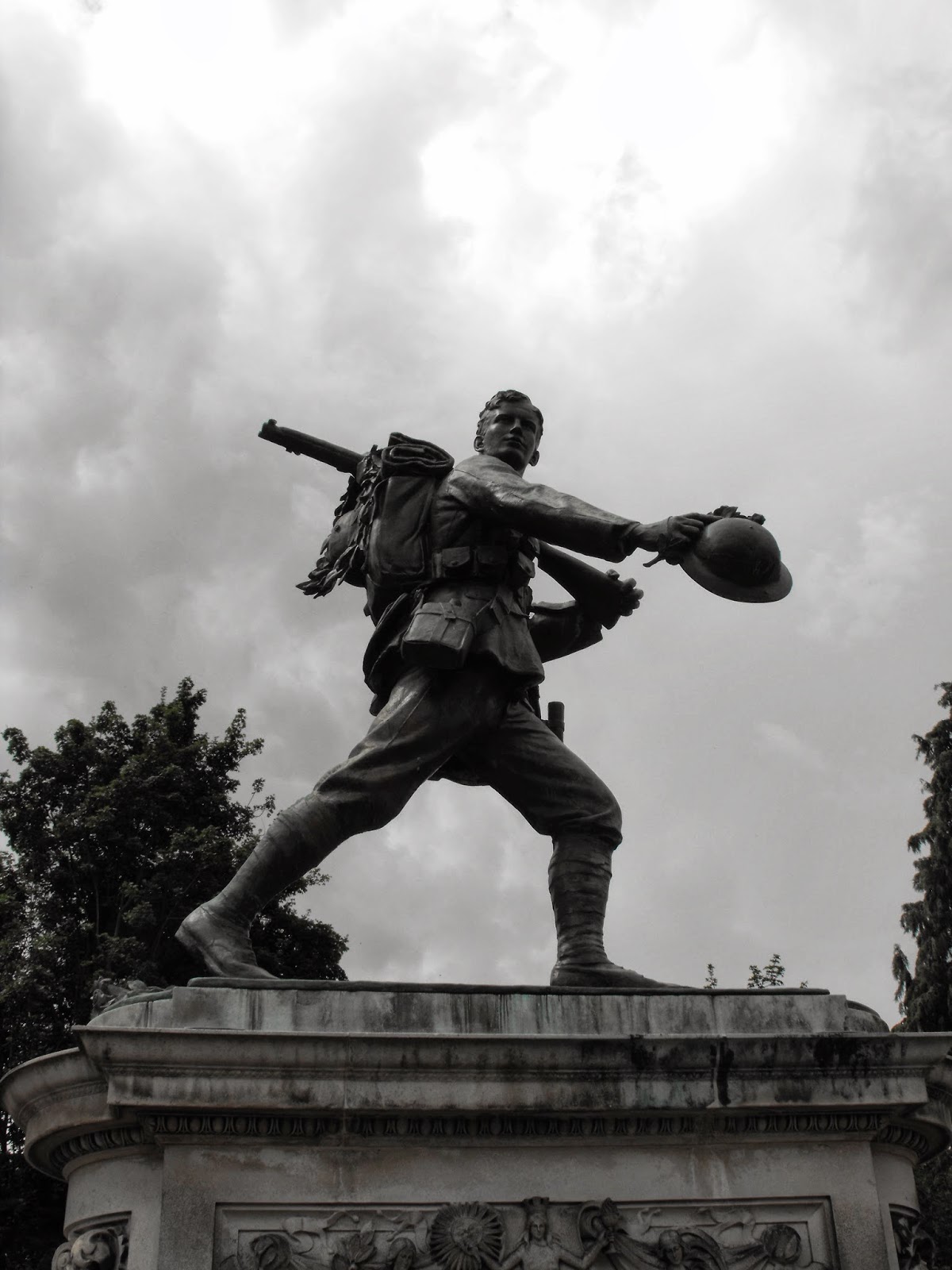
But this memorial in Cambridge is the only British memorial that I can recall as presenting any hint or note of triumph. Entitled “The Homecoming”, it was originally It was originally unveiled and dedicated on July 3, 1923 by His Royal Highness the Duke of York - the future King George VI.

Today it is located at the intersection of Hills Road and Station Road (and the Botanical Gardens there) – the latter leading to the railway station that serves the city of Cambridge, the location to which it was moved in 2012.


The memorial includes a single soldier from the ranks, representing the many men of Cambridgeshire who went off to the war. This figure, however, is striding boldly possibly even gleefully homeward from the wars. The Imperial War Museum's database offers some background information on this memorial.


The memorial was dedicated
"TO THE MEN OF CAMBRIDGESHIRE
AND THE ISLE OF ELY, THE BOROUGH
AND UNIVERSITY OF CAMBRIDGE
WHO SERVED IN THE GREAT WAR
1914-1919
AND IN THE WORLD WAR/ 1939-1945"

- the reference to the Second World War of course being a later addition.


He bears laurel garlands of triumph in his kit and wreathed around the German stahlhelm that is his trophy from the battlefield and signet of victory.


The statue bears the name of its sculptor the names of the memorials sponsors are inscribed on the base. Robert Tait McKenzie was a Canadian American surgeon and sculptor whose interest in the latter reflects and may have been inspired in part by his interest in anatomy and physical fitness. His papers today are now at the University of Pennsylvania.


A very similar (apparently identical) work in the United States is called "The Victor" and was erected in 1925 as a part of the War Memorialin Woodbury, New Jersey. The similarities to “The Homecoming” are evident as are the changes to make this figure a World War I doughboy facing straight ahead as he marches. Personally, I prefer the English version as the soldier’s posture looking to one side from his line of march is much more evocative of the already easing of discipline and the anticipated return to the hard earned joys of peace this soldier would have felt. A Philadelphia Buildings website also presents drawings and other background material on "The Victor" including drawings of how it would look while still merely a proposal. These drawings show how it was already planned for this figure to be different than the one used in "The Homecoming" in Cambridge.

The figure of the British soldier in "The Homecoming" also offers some great details on what his kit would have looked like and how it would have been worn.